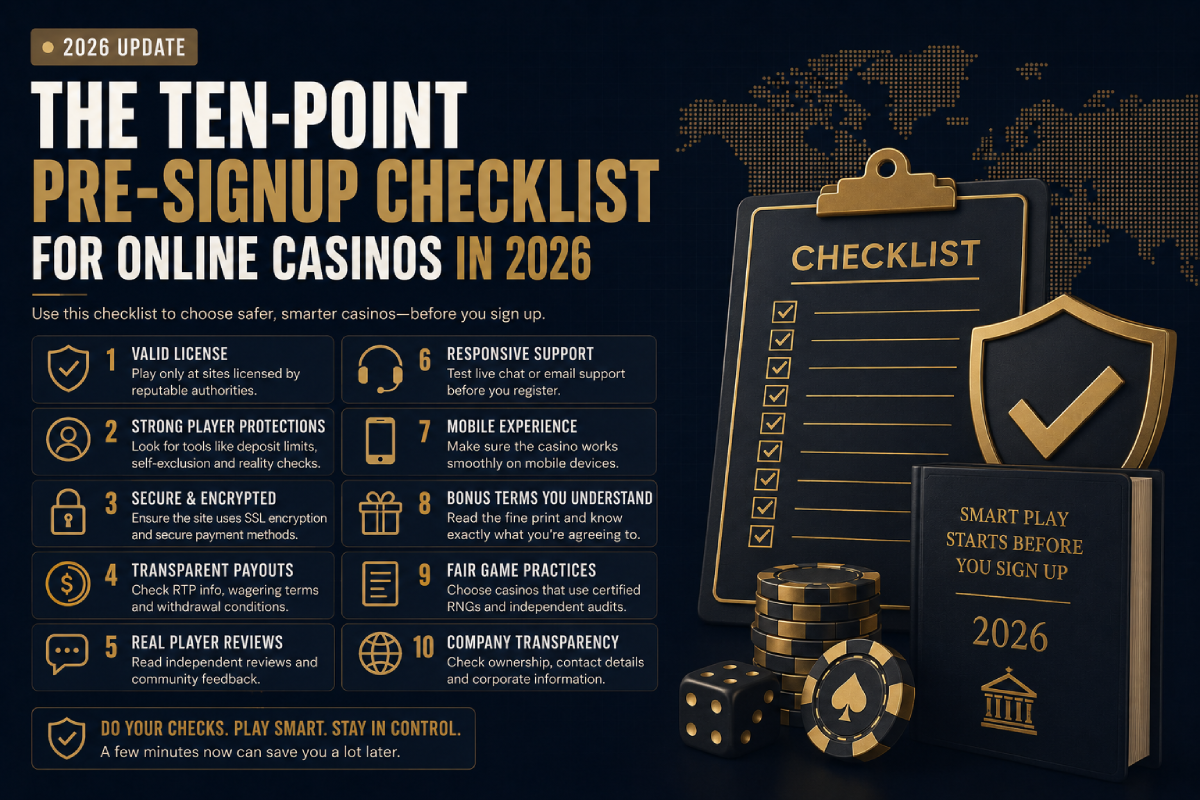
The industry has cleaned up considerably in the last five years, but there is still a long tail of operators that will happily take a deposit and hunt for reasons to slow-walk the withdrawal. The checklist below is what the review desk runs on every new site before we open an account. All ten checks together take about fifteen minutes and reject roughly nine out of ten of the operators that would eventually have ended in a dispute.
1. Licence live-register lookup
Do not trust the footer badge. Copy the operator's company name into the live public register of the regulator it claims to hold a licence with (UKGC, MGA, Spelinspektionen, Curacao's LGCA, ANJ, KSA, and so on). If the name is not listed, or the register lists it as revoked or suspended, close the tab. A live licence is table stakes; forgetting to check it is how most disputes end up unwinnable.
2. Corporate owner and sister sites
Scroll to the footer and note the parent company. Search that name plus the word casino and see what else it operates. If the sister sites include operators with a documented history of voided winnings or freeze-outs, the same team runs this one, and you can expect the same behaviour.
3. Bonus terms scan
Open the terms of the welcome offer, whether or not you plan to claim it. Wagering, max bet, expiry and excluded games. If any of the four sit in the avoid column of a normal player-friendly range (see our bonus decoder piece from earlier this month), that is a soft red flag; the operator is willing to write hostile terms on the front page.
4. Payment methods and fees
Are the deposit and withdrawal methods symmetric? Are there withdrawal fees for anything above zero? Is there a minimum-withdrawal figure larger than a normal session bank? A site that offers instant crypto in but only slow card out, with a fee, is telling you something.
5. Game providers
Reputable operators partner with reputable studios. Pragmatic, Evolution, NetEnt, Play'n GO, Hacksaw and a handful of newer names are safe signals. If the entire library is a single unknown studio, or a mix of clones of well-known titles, the game outcomes may not be independently certified. This one takes ninety seconds to verify from the game lobby.
6. Complaint history
Search the operator name plus complaint or unpaid on two or three independent forums. Every operator picks up a few grumpy customers; a pattern of unresolved payout disputes is the signal you are looking for.
7. A documented KYC path
Somewhere in the terms or help centre there should be a list of accepted documents and expected verification times. If none exists, the KYC process is undefined, which is a euphemism for we will ask for whatever we like on the day you try to withdraw.
8. Live-chat sanity test
Open live chat before you deposit and ask two questions: what is the maximum daily withdrawal, and what documents will you need at KYC. A responsive, specific answer inside three minutes is a good signal. A slow, boilerplate, or contradictory answer is not.
9. Responsible-gambling tools
Deposit limits, session reminders, cool-off, self-exclusion. All four should be one click deep from the account menu. The tools existing is a licence requirement; the tools being easy to find is a culture signal.
10. Small-print red flags
Scan the terms for two clauses in particular. First, a dormancy clause that seizes idle balances after a short window. Second, a maximum-withdrawal-per-week that would take a serious win a year to cash out. Both are legal at most operators, but both are aggressive against players and should push a site down your list.