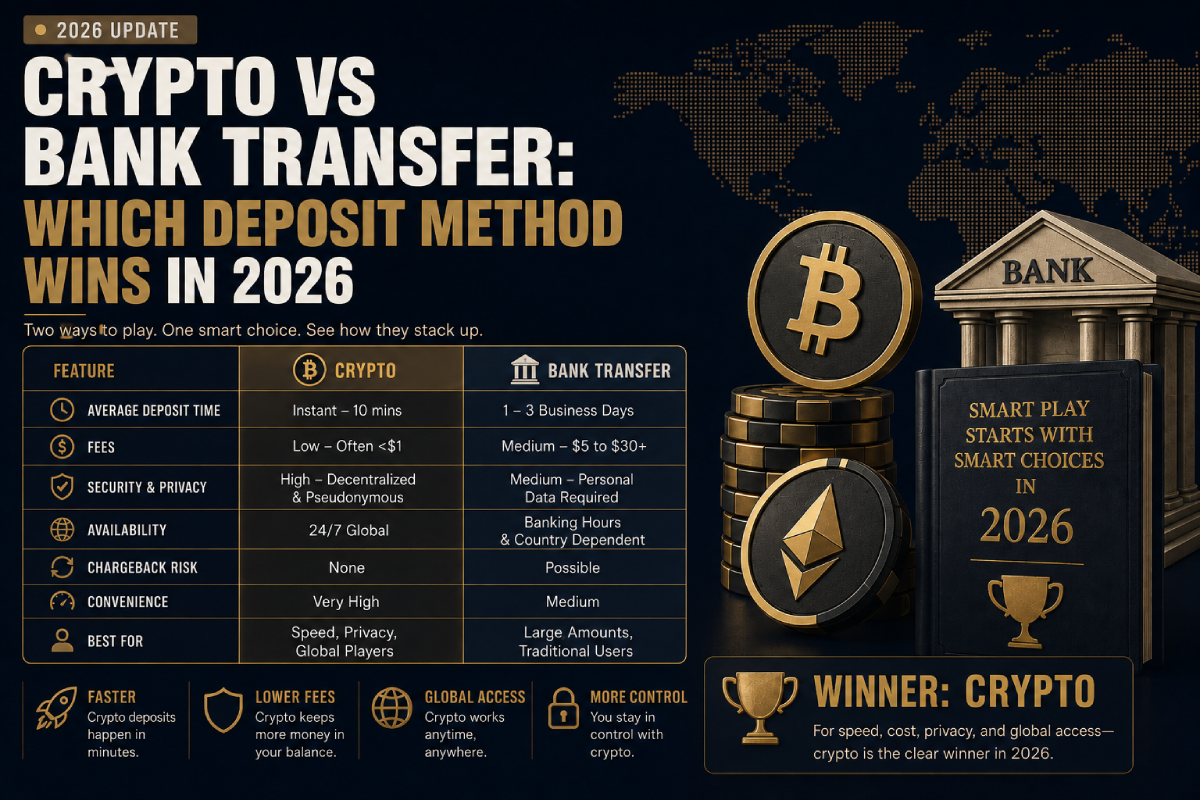
Card deposits are quietly on their way out. In several of our markets they are already blocked, in others they carry surcharges heavy enough to make them a non-starter. The two rails filling the gap are crypto (mostly stablecoins in 2026) and instant bank transfer via Trustly, Volt, Pay by Bank and the local equivalents. They cover very different needs, and the wrong choice can cost you either a delayed withdrawal or a lost dispute later.
Speed
On the deposit leg the two rails are effectively tied: stablecoin deposits show in the balance in under two minutes on every operator we cover, instant-bank deposits arrive in under five. On the withdrawal leg crypto is a small step ahead (median 18 minutes to cleared, versus 32 for instant bank in our latest audit) but the gap is not what it was.
Cost
Instant bank is free at almost every mainstream operator, both directions. Crypto is free on the operator side but carries an on-chain fee, which for stablecoins on modern chains is fractions of a cent and for Bitcoin on the base layer can spike into the low single-digit euros around peak times. On a monthly-play basis the cost difference is negligible for either.
Privacy
Instant bank is fully attached to your identity from the second you initiate it. Crypto is pseudonymous on-chain but every regulated operator in Europe now requires the same KYC on a crypto deposit as on a bank deposit, so the operator-side privacy gain is basically zero. Where crypto does help is at the network level: your bank has no visibility of the transaction, only your exchange (if you buy first) or your wallet history. If your bank flags gambling-related debits and you want to reduce that footprint, crypto genuinely helps.
Dispute rights
This is where instant bank wins clearly. A bank transfer is inside the regulated banking rails; a mis-processed or unfairly-voided transaction gives you a formal complaint route via the payment provider and, in many jurisdictions, the financial ombudsman. Crypto is one-way. Once you send USDT or BTC to a casino's wallet, there is no external body to appeal to, only the operator's own complaints team and the licensing regulator. If the casino refuses to release funds, you are relying entirely on regulatory pressure and public accountability. On unlicensed or lightly-licensed sites, that is a thin safety net.
Bonus eligibility
Historically many welcome bonuses excluded certain deposit methods. In 2026 that has largely reversed: instant bank is universally eligible, and stablecoin deposits are eligible at a growing majority of crypto-friendly operators. Do skim the terms though: a handful of sites still exclude e-wallets, and a handful of hybrid sites cap the bonus size when the deposit is in crypto.
The verdict, for most players
If you play at a licensed operator inside your own market and want the strongest safety net, use instant bank. You give up a few minutes on the withdrawal and gain a formal dispute route you may never need. If you play across offshore sites, deposit larger amounts, or care about the network-level privacy of the transaction, stablecoins are the better fit. The important thing is to pick one and stick to it for both deposit and withdrawal, because mixing rails is the single most common cause of extra KYC checks on the way out.