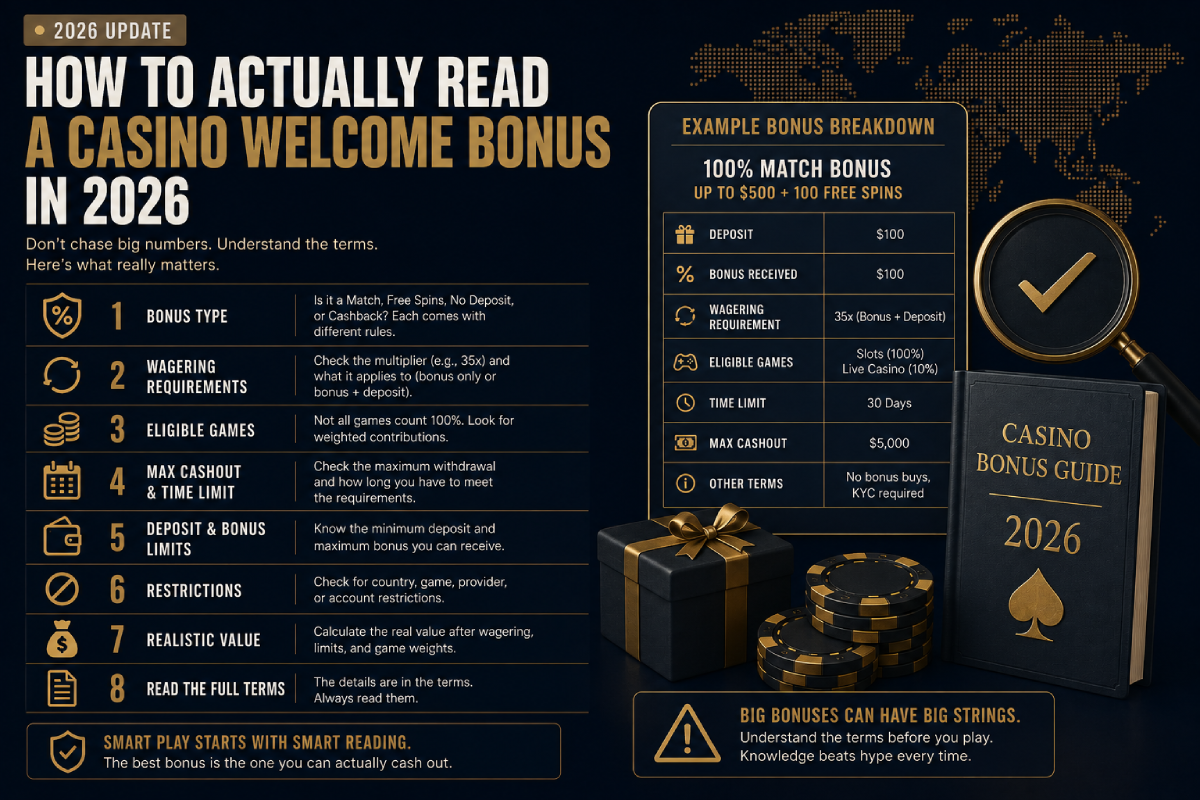
Every operator on our books offers a first-deposit bonus of one shape or another, and every one of those bonuses is sold on a single big number, the match percentage, the free-spin count, the total headline value. That single number tells you almost nothing about whether the offer is worth claiming. What actually decides the outcome is a group of four smaller numbers buried in the terms, and once you know what to look for you can read a bonus in about ninety seconds.
The wagering multiplier
Wagering, sometimes labelled playthrough or rollover, is the amount you have to bet before the bonus becomes withdrawable money. It is quoted as a multiplier of the bonus itself, or of the bonus plus your deposit, and the difference between those two bases is enormous. A 30x rollover on a €100 bonus is €3,000 of turnover. The same 30x on bonus-plus-deposit for a €100 match with a €100 deposit is €6,000. Same headline, twice the work.
The realistic sweet spot in 2026 is anything at or under 35x on the bonus alone. Above 40x on bonus-plus-deposit and the maths starts to move against a normal recreational player. Above 60x on anything, walk away.
Game weighting
Slots almost always count 100% toward wagering. Blackjack, roulette and video poker frequently drop to 10%, 5% or even 0%, which means an hour of table play may barely touch the rollover. If you prefer tables, a slot-only bonus is a bad fit even at a friendly multiplier. Check the excluded-game list too: many providers now block progressive jackpots, high-RTP variants and certain live studios entirely.
Max bet cap
Almost every welcome offer caps the stake per spin while the bonus is active. €5 is common, €4 or €3 is not unusual, and any stake above the cap is grounds to void the balance without warning. The cap is enforced silently by the platform, so a €0.50 accidental over-bet on a €5 cap looks fine on the screen but flags the account internally. If you know you like to open a session with a couple of higher-stake spins to feel out a slot, a bonus with a €2 cap is a permanent handbrake.
Expiry window
The whole wagering has to be cleared inside a fixed window, usually seven to thirty days from claim. Divide the turnover requirement by the days you actually plan to play and see whether it fits your normal session pace. Chasing a bonus at 4am on day seven because the clock is running out is exactly how balances get lost.
| Term | Player-friendly | Standard | Avoid |
|---|---|---|---|
| Wagering (bonus only) | 25x or below | 30 to 35x | 50x or above |
| Wagering base | Bonus only | Bonus only | Bonus plus deposit |
| Max bet | €5+ | €4 to €5 | €2 or below |
| Expiry | 30 days | 14 to 21 days | 7 days or less |
| Game weighting | Full slot list, 10%+ tables | Most slots at 100% | Long excluded list |
A worked example
Take a headline offer of a 100% match up to €200 with 35x wagering on the bonus. Deposit €200, claim €200 in bonus. Wagering to clear: €200 × 35 = €7,000 of turnover. At an average slot RTP of 96% the mathematical loss on that turnover is about €280. If the bonus itself is only €200, the expected outcome is negative before you factor in variance and the max-bet cap. Now compare the same 35x on the deposit-plus-bonus base: €400 × 35 = €14,000 turnover, expected loss around €560. The offer looks the same on the landing page but the second version is roughly twice as expensive to complete.
Verdict
The headline is the marketing, the four numbers are the product. Skim the terms in the order above, run the turnover through a calculator, and if it fits inside your normal weekly play there is no reason not to claim. If it does not, decline the bonus, deposit the amount you would have staked anyway, and keep the withdrawal path clear. A refused bonus is not a lost bonus, it is an unclaimed handbrake.